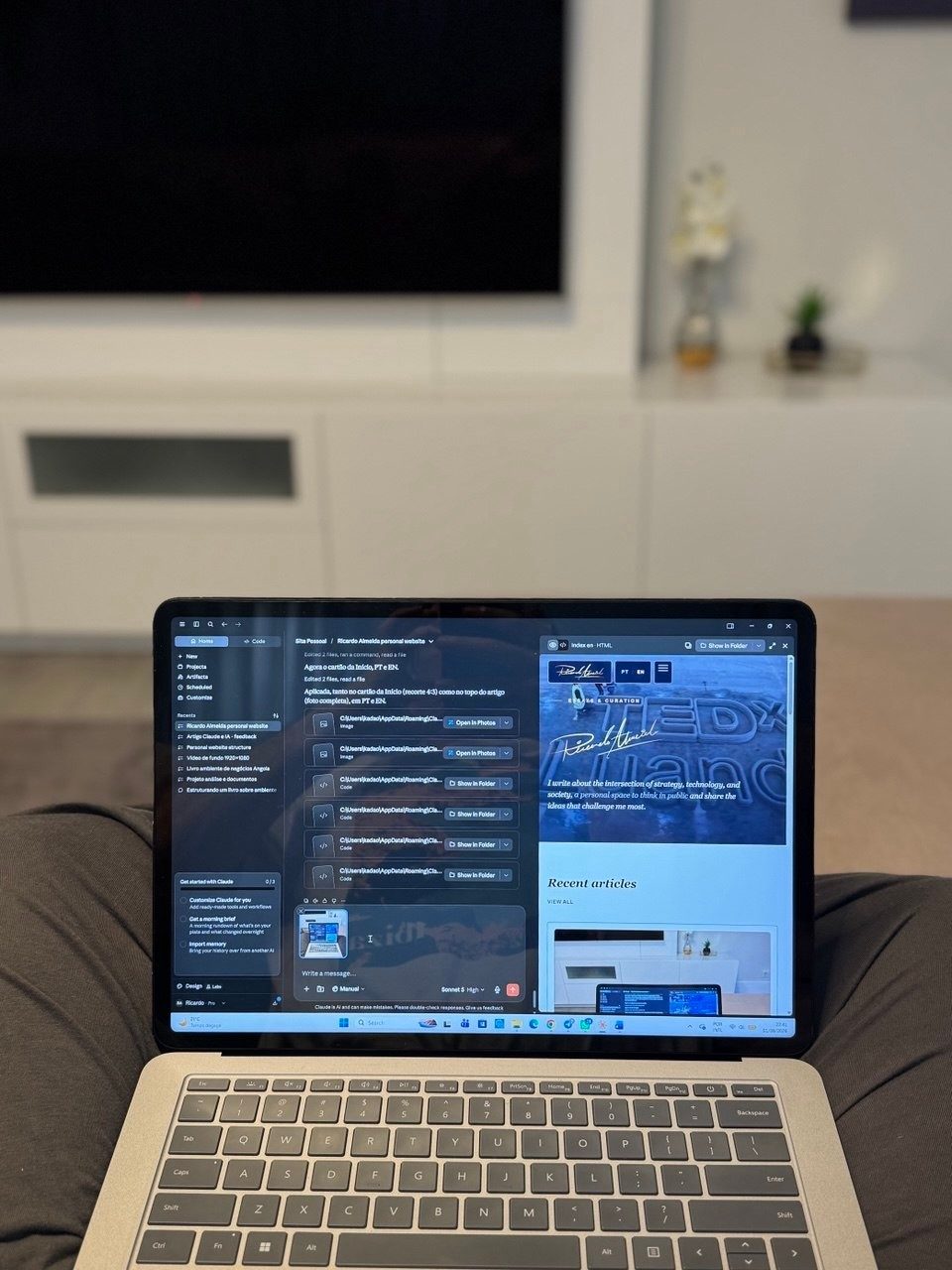
I ended up going to sleep at four in the morning. Or rather, I was forced to. It was the worst night's sleep I'd had in months, and one of the best decisions I've made this year.
I've used artificial intelligence since ChatGPT came out. I have paid accounts with ChatGPT and Grok and use them regularly to help me get started on texts, proposals, memos, opinions, and other documents.
I always saw them as useful tools, but never transformative. They made the work easier, justified the cost, but always required checking, reviewing, and reviewing again. They had never truly changed the way I work.
Last week I met up with Bruno Carlos, friend, business partner, and a true brother from another mother. He's talked for a long time about the revolution artificial intelligence is going to cause. I'd listen, read articles, and follow the topic out of curiosity, but I remained convinced it was just another incremental improvement.
In that conversation we came back to artificial intelligence, and Claude in particular. This time I didn't just listen: I decided to test it. Around nine at night I downloaded the app.
With the kids on holiday, the house was full of nephews and nieces, noise, and chaos. I went to bed close to midnight and told myself I'd try it for a few minutes.
It was like playing Civilization. Always "just one more turn." Before I knew it, it was four in the morning. My head was racing, full of ideas, right when the free version decided to remind me I'd run out of tokens.
I got genuinely irritated. Not because I was tired. Quite the opposite. If the tokens hadn't run out, I probably would have kept going for a few more hours. But there was no alternative. I was forced to go to sleep.
By eight I was up, phone in hand. A few hours later I hit the exact same limit again. I realised I'd already made the decision. That night, while I was at the Colombo mall with my youngest son, I subscribed to the Pro plan.
After trying out a few writing projects, I wanted to see how far this tool could take me without writing a single line of code myself.
I picked a project that had been stalled for years: this site. I first thought about it at the end of the pandemic. There was never time. It was never a priority. It sat parked for almost four years.
On Saturday I didn't even leave the house. I'm still in my pyjamas as I write this. I put the concept together, bought the domains, built the site, went through more than forty rounds of changes, wrote the first article, wrote this second one, paid for hosting, and published it all.
All of it in one morning. Without writing a single line of code. Just ideas, requests, revisions, and a lot of conversation.
When I published the site, I immediately thought of Cape Town and my older brother, Luís Miguel.
In 1998, he decided to build the first website for the #Angola channel on mIRC, which was then the main meeting point for the Angolan diaspora on the internet. Long before WhatsApp, Facebook, or social media existed, that was where friendships were made, romances began, rivalries were born, and meetups were organised.
His nick was Mo_Mike. He bought an HTML book and taught himself. He wrote the whole site by hand, line by line, while he was still learning the language. Along the way he dealt with Windows 95, Internet Explorer, and the inevitable Blue Screens of Death. It took him close to six months to finish.
Today, in one morning, without writing a single line of code, I did the equivalent.
Not because I work faster. Because the tools changed.
In a few years, no one will argue over whether, in 2026, Claude was better than ChatGPT, Grok, or any other model. Those comparisons age fast. I suspect this is only the first shift. The deeper one is still to come.
When that happens, the advantage will no longer be in using artificial intelligence. It will be in who learned to work with it first.
No tool has ever changed the way I work this fast.